The Benefits of Migrating Website From WordPress to Next.js
Discover why migrating your website from WordPress to Next.js brings real business benefits, from performance and SEO to security and future scalability.
Choosing the right framework is one of the most important decisions for a modern website. WordPress has served many businesses well, but as websites grow, it can become slow, hard to maintain, and prone to security issues.
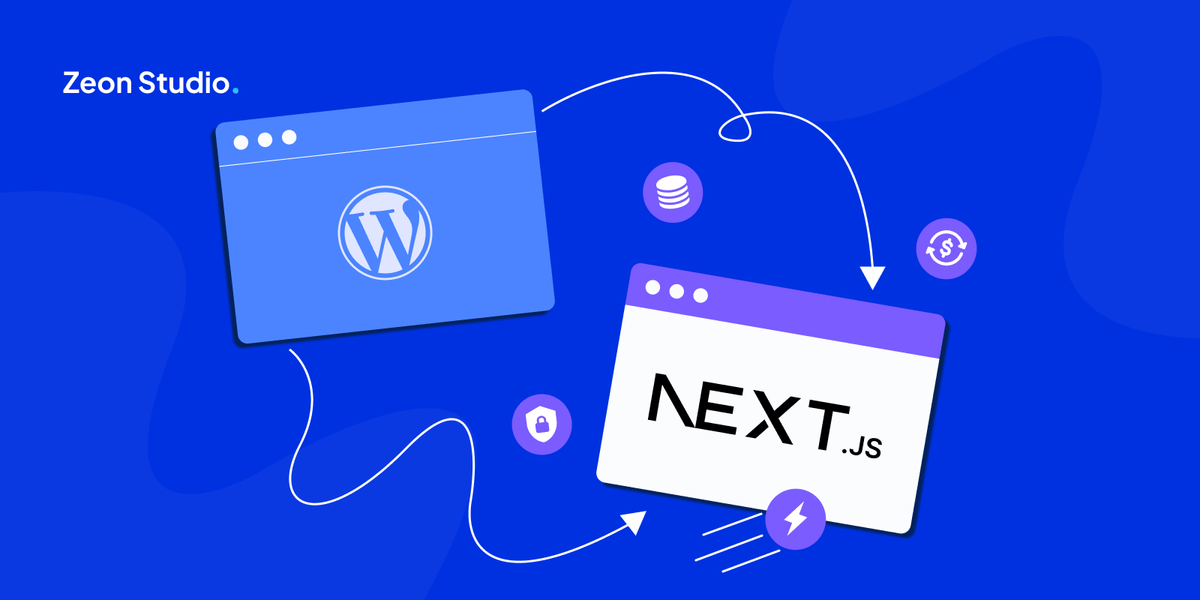
More businesses are moving away from WordPress and switching to Next.js for faster performance, stronger SEO, and better long-term growth. Next.js offers a modern, future-ready solution that improves speed, scalability, and content management, giving your business a website that can grow with you.
At Zeon Studio, we help companies migrate smoothly, preserving SEO, improving performance, and making content updates easier for teams.
Key Business Benefits of Migrating From WordPress to Next.js
Lightning-Fast Performance
Next.js websites load much faster than traditional WordPress sites because there’s no heavy plugin system slowing things down. Faster loading means visitors stay longer, bounce less, and are more likely to convert. A speed boost directly helps your sales, sign-ups, and overall user experience.
Strong SEO Improvements
Next.js offers server-side rendering and a cleaner site structure, which makes it easier for Google to crawl and index your pages. The result is improved search visibility, better ranking stability, and stronger performance for content-heavy websites. Search engines prefer fast, organized websites and that’s exactly what Next.js delivers.
Better Security With Fewer Vulnerabilities
WordPress depends on plugins, and each plugin is a potential security risk. With Next.js, you don’t rely on dozens of third-party extensions, so the attack surface becomes much smaller. This reduces the chances of hacking, data leaks, and constant security updates.
Scalable for Future Growth
As your traffic grows or your business expands, Next.js scales easily. Whether you’re running a SaaS platform, an eCommerce store, or a large content site, Next.js handles growth without performance issues. It’s built for long-term stability, not band-aid fixes.
Better Customization & Content Control
When paired with a headless CMS, Next.js gives you complete flexibility over your design and content. WordPress theme or plugin restrictions are no longer a limitation. You get the freedom to build any layout, add custom features, and manage content in a way that fits your workflow — not the other way around.
How the Migration Process Works (Simple & Business-Focused)
Audit of Website & Content
The process starts with a full review of your existing WordPress site’s pages, content, design, speed, and SEO. This helps identify what should stay as it is, what needs improvement, and what can be removed to keep the new site clean and efficient.
Design Refresh or UI/UX Upgrade
You can keep your current design if you love it, or take the opportunity to modernize the look and feel. This step ensures the new site feels faster, cleaner, and more aligned with your brand.
Build With Next.js + Headless CMS
Your website is rebuilt using Next.js and a headless CMS, giving you a more modern, flexible, and future-proof foundation. This setup removes plugin dependency and gives you better control over content and performance.
Content Migration Without Losing Data
All essential content pages, blog posts, images, and metadata are safely migrated from WordPress. Nothing gets lost, and everything is reorganized cleanly for better performance on the new platform.
SEO Preservation & Redirects
Your SEO is protected with proper URL mapping and redirects. All old WordPress links continue working, so you don’t lose rankings, traffic, or backlinks during the migration.
Speed, Performance & QA Testing
Before launch, the entire site is tested for speed, responsiveness, and overall experience. This ensures the new site feels smooth, loads fast, and works perfectly across devices.
Deployment & Handover
Once everything is ready, the website goes live. Your team receives full training on updating content, managing the CMS, and using the new system confidently.
For Business and SaaS companies, Next.js gives you full control over performance, SEO, and integrations. None of which WordPress handles well at scale. Zeon Studio has helped SaaS companies like Supernova make this exact transition successfully.
Cost & Timeline Expectations (Founder-Friendly)
Migrating from WordPress to Next.js isn’t a one-size-fits-all project. Different businesses have different needs, so here’s a realistic breakdown of what founders can expect:
Small Business Website
If you have a simple website with standard pages (Home, About, Services, Blog), the website migration is usually straightforward. Costs stay on the lower end, and timelines are faster because there are fewer pages and features to move.
Growing Startup or Content-Heavy Brand
Startups with larger blogs, resource hubs, or multiple landing pages need a more structured migration. It takes a bit longer because performance, SEO, and design are usually upgraded simultaneously; however, the results yield measurable improvements in speed, conversions, and brand presence.
eCommerce or SaaS Platform
These migrations require the most planning. There’s user data, product catalogs, dashboards, or API integrations. The work is bigger, but businesses in this category benefit the most from Next.js because it handles scale, traffic, and complex features far better than WordPress.
What Increases or Decreases Cost
Migration cost and timeline depend on a few practical factors. The more pages your website has, the more time the migration takes. If you want a full redesign instead of keeping your existing layout, that adds extra work. Custom plugins, custom features, and advanced integrations also increase complexity. A content-heavy site requires more effort to migrate cleanly.
Smaller, simpler WordPress sites usually migrate quickly. Larger or older sites with many plugins, heavy content, or custom features take more time and resources.
Why Next.js Is a Long-Term Investment
While the upfront effort is higher than a basic WordPress update, the long-term payoff is bigger. You get a website that’s faster, more secure, easier to scale, and doesn’t rely on unstable plugins. Over time, this saves money on maintenance, SEO issues, performance fixes, and redesigns.
Next.js sets your business up for growth, not just for today, but for the next several years.
Conclusion & Next Steps
Migrating from WordPress to Next.js is more than a technical upgrade; it’s a long-term business advantage. You get a faster website, stronger SEO foundations, better security, and a platform that can grow with your company.
If you’re ready to explore what this move could look like for your brand, explore our real migration results in the Zeon Studio case studies, or talk directly with our team, connect with Next.js migration experts at Zeon Studio, and plan your upgrade with confidence.